Ask and Find
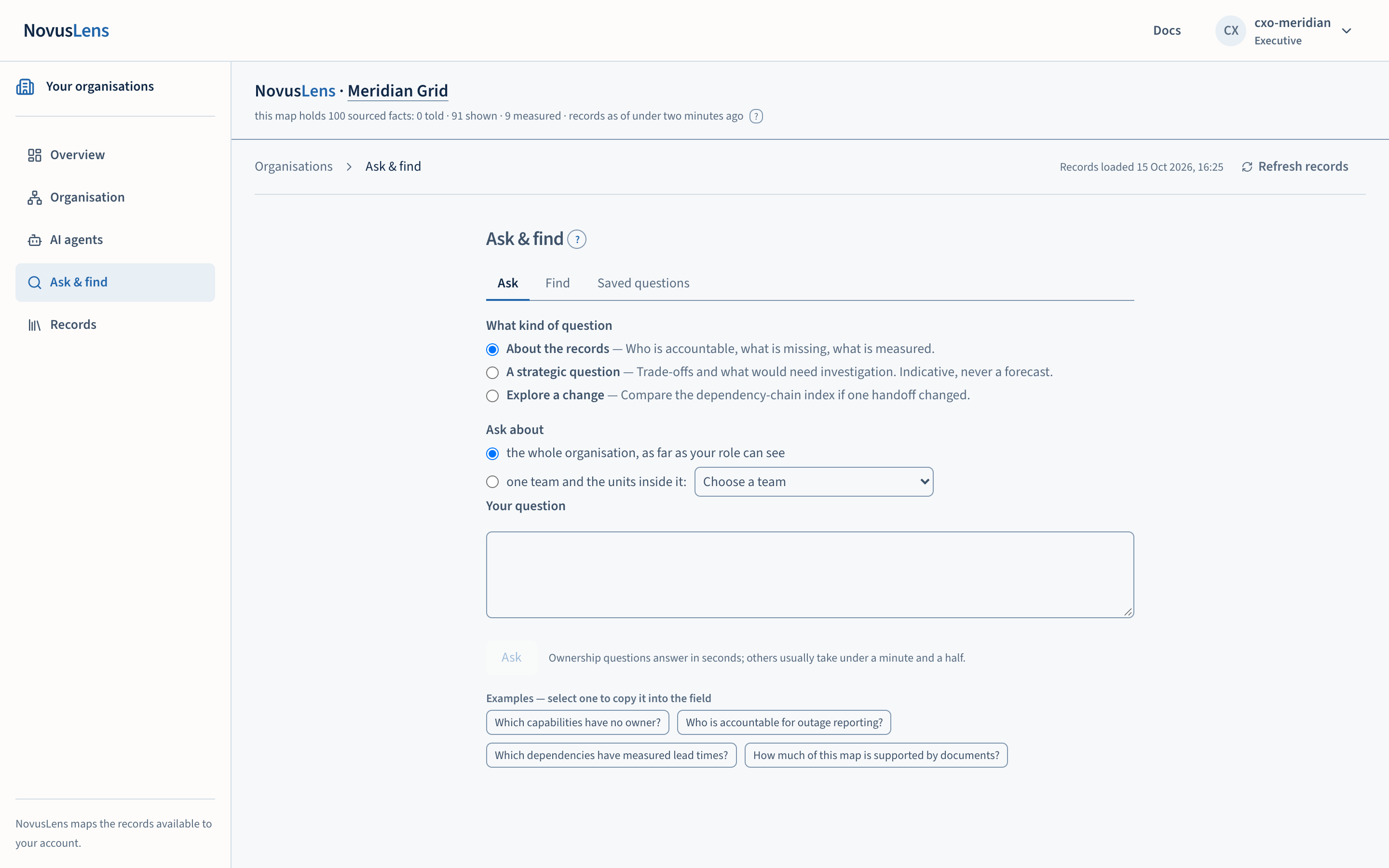
What you are seeing. Three tabs. Ask puts a question to the records and composes an answer. Find lists the records that match a word or a name. Saved questions keeps your questions from the last 24 hours.
Example. Ask “Which capabilities have no owner?” about the whole organisation. The answer lists four separate results: recorded as unowned, accountable ownerAccountable ownerThe person recorded as answerable for a team, service or agent. NovusLens does not assume that this person is also the one who runs it day to day. not recorded, operational ownerOperational ownerThe person who runs a team or service day to day. This is not automatically the accountable owner, and NovusLens records the two separately. not recorded, and conflicting assignments. Each statement carries a number, and the number opens the record it rests on.
How to read an answer.
- Answer is what the records support. Each statement’s numbers point to its sources.
- Why gives the mechanism behind it.
- Sources lists each record once. Records that were consulted but not cited are listed apart.
- What this does not establish says what the answer could not cover, such as records outside the chosen team or outside your role’s view.
Choose the scope before you ask. “The whole organisation” means the whole organisation as far as your role can see. “One team” means that team and the units inside it, and nothing else is consulted.
Limits. An answer is composed from records and checked against them. A statement the records do not support is withheld, and the answer says so. A what-ifWhat-ifA scenario that changes one or more dependencies in the model and reports the result. A what-if changes nothing in the records, and its result is indicative. that names a dependency the records do not hold says so and changes nothing. A question about key-person riskKey-person riskA finding about a team on the measured critical path with one to four people represented in the records. It never names those people. answers from the recorded findingsFindingA difference in the records that needs a decision. It includes its sources and can describe a slow handoff, disputed fact or missing owner. and never names a person or a count. An answer about a regulation consults the regulation register before it says anything is absent. “Who answers for” is read as an ownership question and answers from the records in seconds. A strategic reading is indicativeIndicativeThe label on a scenario or what-if. An indicative result shows one possibility under stated assumptions. It is never a measurement of the future., never a forecast.
What you can do next. Open a source to check it. Use Find when you want the records themselves rather than an answer.