Evidence and proof, checked record by record.
Every fact on the mapMapThe view of teams, services and their dependencies for the selected part of the organisation. Details appear beside the map. has a source. NovusLens labels each source’s evidence level and shows where it supports a value. Dates tell you whether the evidence still counts. This page explains those labels and shows you how to open the records behind a team or a findingFindingA difference in the records that needs a decision. It includes its sources and can describe a slow handoff, disputed fact or missing owner.. It also explains the state messages you will meet when a result cannot be fully supported.
A label describes the evidence available. It is not a guarantee that the evidence is correct. A source can be incomplete, out of date or in dispute. Open the record before you rely on a claim.
What you will achieve
You will be able to:
- tell told, shown and measured apart, and see how many teams hold each kind of fact at each level;
- open the records behind a team, and read the source, the location, who supplied it and how strong it is;
- open a finding and see what was recorded, on what basis, and what to review next;
- read a state message and know what it does and does not establish.
Before you start
You need a signed-in account. Teams and findings are shown only within the scopeScopeThe work, data, activity or access that a rule, statement or calculation covers. For access, it names the records an account can see. For team measures, “Own operations” covers the selected unit. “Including descendants” adds the units beneath it. your role may see. Where a record is outside your view, the page says so and does not show it.
Told, shown and measured
These three levels describe what kind of support a record has.
- toldToldEvidence that somebody stated the value. It is the weakest level, and it is always attributed to its speaker. Told. Someone stated it. The statement is attributed to its speaker.
- shownShownEvidence that a document supports a value. A recovery plan that states a target shows the target, but it does not show that the target was achieved. Shown. A document supports it. A document may say what should happen. That does not show that it did.
- measuredMeasuredThe top evidence level: a connected source recorded the observation within a stated period. A measurement shows what was observed on that occasion, not that it always holds. Measured. A connected source recorded an observation within a stated period.
A newer statement does not replace a value supported by a document or measurement without a trace. Where two sources disagree, both are kept for review. Historical records remain available. Retaining an earlier record is not a decision that it is still correct.
toldToldEvidence that somebody stated the value. It is the weakest level, and it is always attributed to its speaker. shownShownEvidence that a document supports a value. A recovery plan that states a target shows the target, but it does not show that the target was achieved. measuredMeasuredThe top evidence level: a connected source recorded the observation within a stated period. A measurement shows what was observed on that occasion, not that it always holds.On the map the levels appear as small labels beside each fact: a hollow circle for told, a half-filled circle for shown and a filled circle for measured. Where a fact can be shown by a document but is never measured, the coverageCoverageWhat the available records cover, and what is missing. A count such as “3 of 5 dependencies measured” names the measured portion and the gap. page reads it as complete at shown, not as deficient.
Evidence coverage
Open Organisation, then Evidence coverage. For each kind of fact, it counts teams holding told, shown or measured records and gives the oldest record’s age. Each kind of fact is named with a short description. Kinds that are not yet described show their internal name.
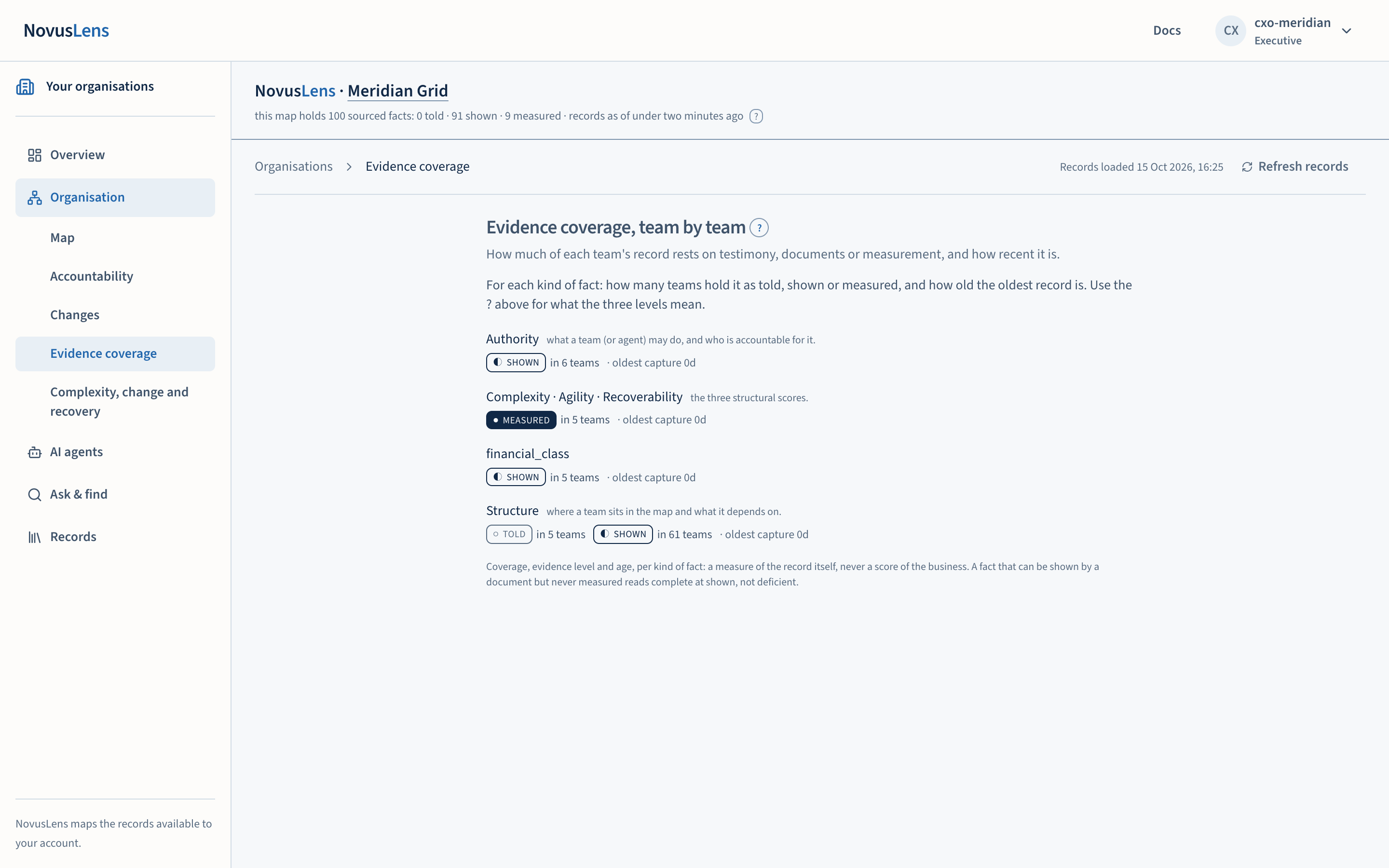
Coverage is a measure of the record itself. It is not a score of the business. A high count of shown records does not mean that the activity is measured. A low count of measured records is not a finding about performance.
Open the evidence behind a team
Select a team on the map, and open the Evidence tab of the panel. Select Open the team’s source evidence. The records open in a drawer beside the page. Each record shows:
- the source, with its kind: Document, Knowledge entry, Measurement, Testimony, Estate export or Finding;
- the location within that source, and the source’s version or reference where one is recorded;
- the strength, as told, shown or measured;
- Supplied by, and who the record was asked for by, where that is recorded;
- Observed, the time the fact was observed;
- Recorded here, the time the record reached NovusLens;
- Why you see it, the reason the record is in your view.
Records are shown only for the part of a source your role may see. Where a value has no record, the drawer says that a value without a record rests on what was said.
Times are shown in your local time. Observed and recorded times are separate. Opening a drawer retrieves the records afresh, and the drawer shows when they were retrieved. Use Reload to fetch them again.
Your role may also let you Challenge this record. Write what the record has wrong and select Record the challengeChallengeA recorded dispute of a value. Both the original and the disputed version are kept, and the challenge is listed under Findings.. Both versions are kept until a person resolves the disagreement. Nothing in the record is edited. The confirmation names where to see the challenge, under Findings. Board accounts read the records and do not see the challenge action.
Open a finding
A finding is a statement that a set of records needs review. Open a finding from the Findings tab of a team’s panel, or from the overview. The supporting-records page then shows:
- the recorded finding, with its status;
- the issue, in plain words, and what was recorded;
- the business context, where a team is named;
- the basis: a measured observation, a calculated indicator or an interpretation;
- the accountable ownerAccountable ownerThe person recorded as answerable for a team, service or agent. NovusLens does not assume that this person is also the one who runs it day to day., or “Not recorded” where no source names one;
- the time the record was observed or assessed;
- the source, and the limitation that applies;
- the next review action, which is to review the underlying records with the accountable owner and record a response.
Open the separate details section for technical information, including the finding identifier and the original record. If a finding has been replaced by one or more findings that name the dependencyDependencyA link where one unit needs something from another. A dependency is not a reporting line: it shows where work relies on something else. more precisely, the page links to them.

Open the told and measured views of a team
The panel header switches every value between What we were told and Current evidenceCurrent evidenceA view that uses only measurements recent enough to count. The “What we were told” view uses recorded statements instead.. The dependency-chain index, also called critical path lengthCPLCritical path length. The total coordination weight of the longest chain of dependencies in the model. NovusLens reports it as index points, not elapsed time. (CPL), changes with the switch, because the two views can weigh the same links differently.
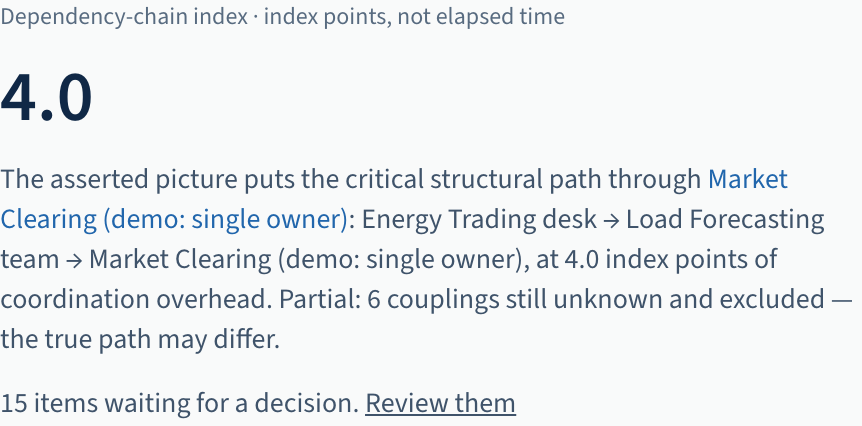
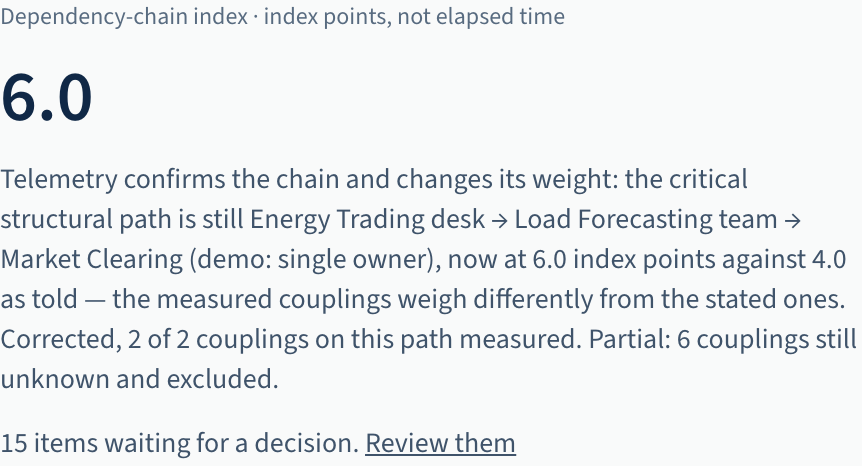
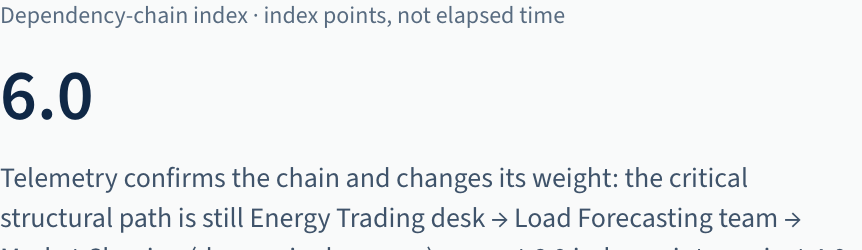
In the measured view, each dependency shows its measured classification, its measured lead timeLead timeThe elapsed time between starting a request or handoff and completing it. where one exists, and the time the observation was made. In the told view, it shows the stated classification and the recorded lead time, with a note that no measured observation is attached. A link is not a reporting line, and a classification is not an assignment of accountability.
The states you will see
Some results cannot be fully supported by the records in view. The page says so beside the result. None of these messages means that a score is zero.
| Message on screen | What it means | What to do |
|---|---|---|
| “records as of” the picture’s age | The map shows how old its picture is. | Check the age before relying on the map. |
| “projectionProjectionThe regular pass that brings the read model up to date with the canonical log. It runs every 30 seconds by default. not keeping up” | The picture is more than three minutes behind the records. | Refresh the records. If the message stays, tell the operator. |
| “analysis incomplete on the last pass” | The records were loaded but an analysis step failed. The stage that failed is named. | Tell the operator. What you see may be older than the records. |
| “records refresh only when someone saves” | No refresh pass has been recorded on this installation. | Tell the operator. The picture changes only when someone saves. |
| “coverage incomplete — no all-clear” | A source did not cover every stream it declares. | Read what was seen. Nothing is said about what was not seen, and silence is not reassurance. |
| “Review required: authority not established” | Observed activity falls outside a remitRemitA written list of an agent’s allowed actions, resources and destinations for information. The list states whether it is complete. that is not declared complete, or no eligible remit applies. | Ask the responsible person to confirm the permitted activity and whether the list is complete. |
| “Unknown”, with a reason | A calculated indicator cannot be calculated from current, eligible evidence. | Open the reason and ask the owner of the missing input. |
| “support has run out” (support lapsed) | A boundary feedBoundary feedRecords supplied by the customer’s own systems about activity at the edge of an agent or service. NovusLens reads those records; it does not watch the agent. was last read more than three of its refresh intervals ago. Findings built on it are withheld until current evidence supports them again. | Ask the operator to read the feed again. Check that the refreshed evidence still supports the finding. Its history is kept. |
| “Illustrative calibrationCalibrationThe customer's own rule that turns raw figures, such as a gauge, a workflow history or an incident log, into a C/A/R score. A score moves when the calibration moves, and the change is recorded. using synthetic evidence” | The value comes from a demonstration calibration. | Do not treat it as a customer benchmark. |
| “Simulated estateSimulated estateA set of example agents supplied for testing and demonstrations. Their findings carry the label “(simulated estate)”. Real customer reports do not carry that label.: demonstration records, not customer performance evidence” | The records come from a simulated source. | Use them to see the product, not your organisation’s performance. |
Simulated records carry their label on every record, so they cannot be mistaken for a customer feed. Only a real customer feed may be read as your measurement.
Finding kinds you will meet
The table lists the finding headlines the interface uses most often. The first column is the wording on screen.
| On screen | What it means |
|---|---|
| Conflicting evidence recorded | Two sources disagree about the same subject. Both accounts are kept. |
| Dependency measured for the first time | A dependency was measured for the first time. There was no earlier estimate to compare, so this is not a contradiction. |
| Reported and measured dependency differ | A reported dependency and a measured one differ, for example in classification. |
| Observation has no matching declared dependency | A measurement matches no declared dependency, or a name shared by several. Nothing was guessed. |
| Accountable owner not recorded | No source names an owner for a team or capability. |
| Activity recorded outside a declared complete remit | An agent’s activity falls outside a remit that is declared complete. |
| In the cloud account, not in the infrastructure codeInfrastructure codeFiles that describe the computing resources an organisation intends to create and how they should be configured. | A resource reported by the provider is not described by the infrastructure code. |
| In the infrastructure code, not reported by the provider | The code declares a resource the provider does not report. |
| Network forwarded traffic outside the declared egressEgressTraffic leaving a system or network for another destination. | Traffic was let through to a destination the declared egress does not include. |
| Network dropped egress attempts (not a gatewayGatewayA service that accepts requests and passes them into another system. The Mycelium gateway gives NovusLens access to the mesh. decision) | The network dropped connection attempts. No gateway saw them. |
| Observation source purgedPurgeRemoving a stored document’s contents while keeping a record that it was removed and why. Conclusions that used it must be checked again.; measurement withheld | A source document was purged, so the measurement is not applied. |
| Reported account to review | A reported account needs review. |
A finding is not a verdict. Its status says whether a response has been recorded. Resolving a finding records a response. Most findings need a human response. Some fixed checks close their own findings when the recorded condition clears, with the reason kept in history.