How to read the organisation map
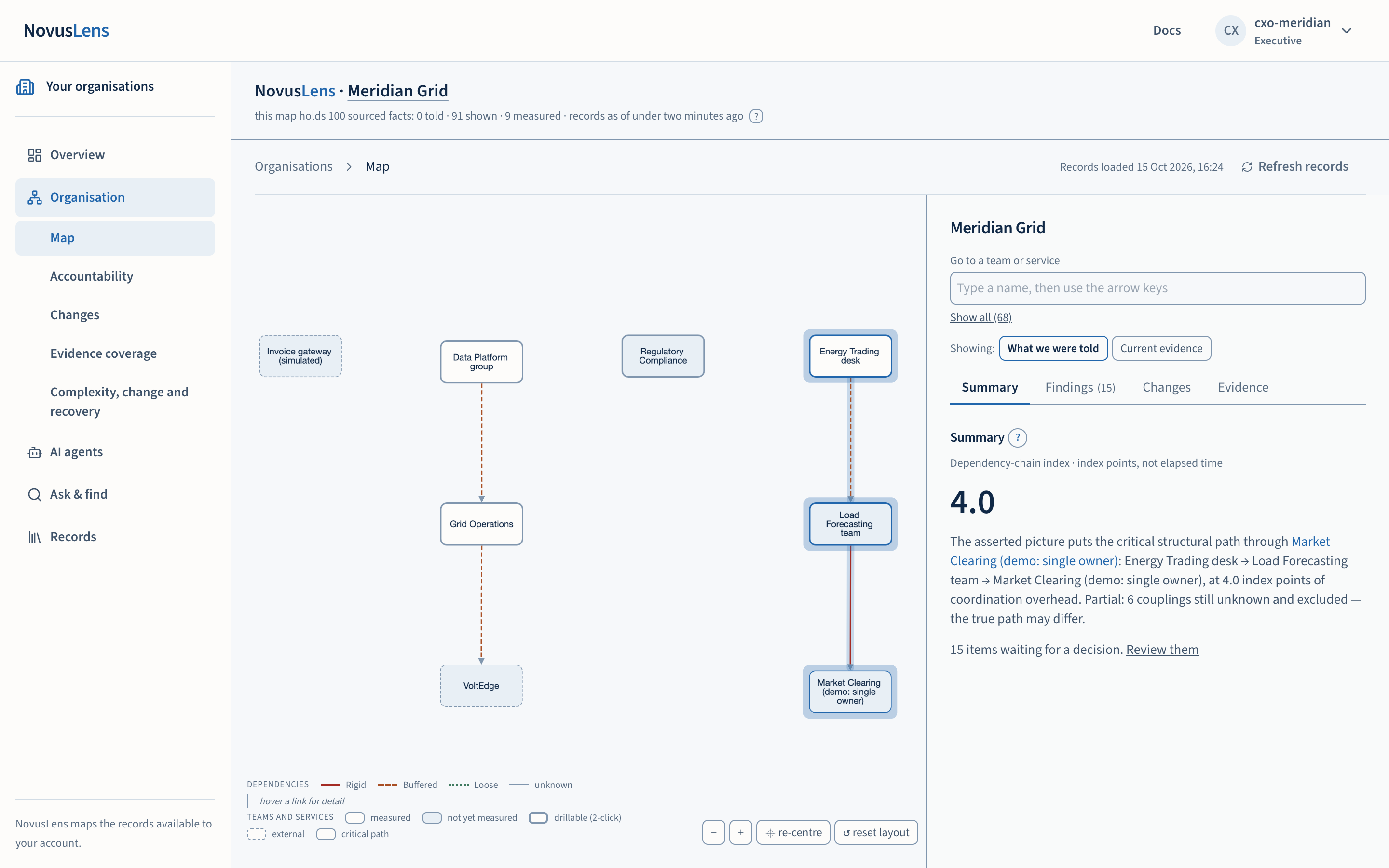
A cellCellA box on the map that stands for a team, service, supplier or AI agent. It is a unit you can inspect, not necessarily a department or a person. is a box representing a team, service, supplier or AI agent. It is a unit you can inspect, not necessarily a department or a person.
A dependency means one unit needs something from another. A sales team may depend on Finance to approve an order. A handoffHandoffWork or information passed from one team or service to another. Its measured or stated completion time determines the dependency class. is the work or information crossing that link. “CouplingCouplingA link where one team or service depends on another. Its Loose, Buffered or Rigid class describes the time needed for a handoff.” describes the dependency and how tightly the units need to coordinate.
A dependency link is not a reporting line. The hierarchy shows which units contain other teams or services; the dependency links show where work relies on something else.
LooseLooseA handoff that takes about one day or less. It adds 0.5 points to the dependency-chain index., BufferedBufferedA handoff that takes more than one day and up to four days. It adds 1 point to the dependency-chain index. and RigidRigidA handoff that takes more than four days. It adds 3 points to the dependency-chain index. are the model’s dependency classes, read from how long a handoff takes to clear: about a day or less is Loose, up to four days Buffered, longer is Rigid. Example. Bookings posts requests into a queue that Customs clears in two days, so this link is Buffered. Customs waits five days for Legal’s approval before filing, so that link is Rigid. Open a link’s evidence to see the measured or stated handoff time behind its class. Unknown means the record cannot establish a class; it is never defaulted.
What to discuss next. For a Rigid link, ask both teams what they wait for and whether a queue, a standing decision or a shared record would let them stop waiting. For a Buffered link, ask how often the queue backs up.
Try this. Select a box, read its owner and purpose, then follow one dependency. Open its source and ask whether it matches how the work happens. Use the team search to find a unit; open its underlying teams and systems when you need more detail.
The selected scope is the part of the organisation you are looking at. A supplier can sit outside your organisation and still be a critical dependency. Missing records are questions to investigate, not empty space that proves there is no dependency.